
Denys Chumak
13 Sep 2022
Dream About the Devil Meaning: Why Your Mind Goes There
In short: The devil in a dream usually stands for temptation, guilt, or a part of yourself you have disowned. What it wanted from you carries the meaning.
You woke up shaken, maybe even a little afraid to close your eyes again. Seeing the devil in a dream can feel like more than just a strange mental image, it can feel like a warning, a judgment, or proof that something dark is living inside you. If you are lying awake right now wondering whether this dream means something is wrong with your soul, take a breath. It almost never does.
Dream researchers and therapists who work with dream content agree that figures like the devil are rarely literal. They are stand-ins, built from religious upbringing, movies, guilt, fear, or whatever your mind associates with temptation and danger. Let's go through what is actually going on.
What dreaming about the devil commonly means
At its core, the devil in a dream usually represents a part of yourself or your life that you have labeled as bad, shameful, or forbidden. It is rarely about literal evil. More often it points to:
- A desire or impulse you have been suppressing, maybe anger, ambition, lust, or selfishness, that your waking mind judges harshly
- Guilt over a choice you made or are considering
- A person in your life who feels manipulative, controlling, or dangerous
- Internal conflict between what you want and what you believe you should want
- Fear of losing control, whether over your behavior, your health, or a situation at work
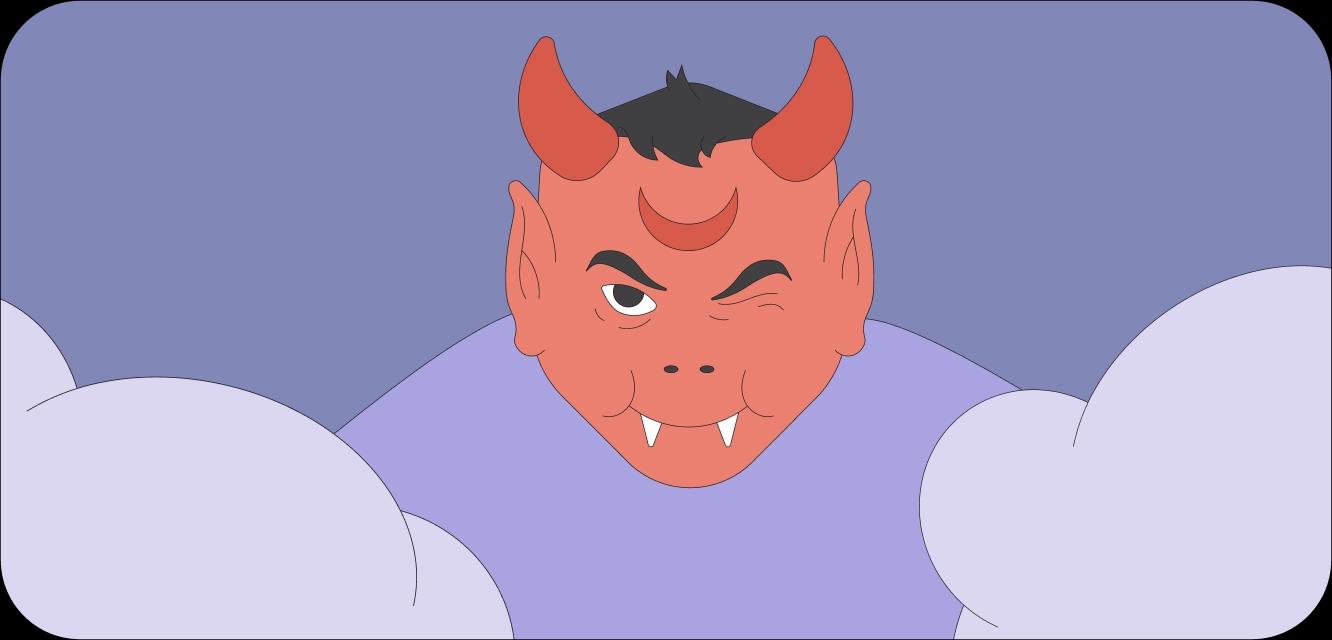
Jung would call the devil figure an expression of the shadow, the disowned parts of yourself that you push out of conscious awareness because they do not fit the image you want to present to the world. Freud, working from a different angle, would likely connect it to repressed drives, the urges your conscience keeps locked away during the day that resurface once your defenses relax in sleep. Either way, the devil tends to show up precisely when you are wrestling with something you have not let yourself look at directly. You can read more about this specific figure in the devil dream symbol guide, which breaks down common appearances and what they tend to track back to.
It also matters how the devil behaved in your dream. A devil who is chasing you is different from one who is talking to you calmly, and both are different from one who is simply standing in the background watching. The emotional tone of the dream usually tells you more than the image itself.
Common scenario variations
Being chased by the devil
This is one of the most frequent versions people report, and the feeling of being chased almost always maps onto something you are avoiding in waking life. It might be a conversation you keep postponing, a decision you do not want to make, or a truth about yourself you are not ready to face. The devil here is less a villain and more a messenger, pointing at the exact thing you are running from. Ask yourself honestly what you have been avoiding lately. The answer is usually not far from the surface.
Making a deal or signing a contract with the devil
This scenario often shows up when you are facing a real decision that involves some kind of compromise, maybe taking a job you feel uneasy about, staying in a relationship that costs you something, or cutting a corner to get ahead. The dream is dramatizing the sense that you are trading something valuable, your integrity, your time, your peace, for a short term gain. It does not necessarily mean the choice is wrong, but it does mean part of you is weighing the cost more seriously than you are admitting during the day.
The devil talking to you or trying to convince you of something
When the devil speaks in a dream, pay close attention to what it says, because dream dialogue often contains a distorted version of your own inner voice. This can reflect self-doubt, a critical inner voice that tells you that you are not good enough, or a temptation you are quietly entertaining. It can also represent persuasive people in your life whose influence you are not sure you trust.
Fighting or defeating the devil
Dreams where you stand up to the devil, push it away, or win a struggle against it tend to reflect a moment of real psychological strength. This often appears during periods when you are actively resisting a bad habit, setting a boundary with someone, or working through guilt in therapy or self-reflection. The dream is rehearsing your resolve, almost like your mind practicing the fight before you have to do it again while awake.
Seeing the devil in disguise, as a friend, stranger, or even yourself
This variation tends to be unsettling because it blurs the line between good and bad. If the devil appears wearing a familiar face, including your own, it may be pointing to a fear that you are capable of something you do not want to admit, or that someone you trust has a side you have not fully seen yet. It is worth noting who the face belonged to and what your relationship with that person actually feels like right now.
A calm or even friendly devil
Not every devil dream is frightening. Sometimes the figure is oddly relaxed, charming, or even helpful. This version often shows up when you are starting to make peace with a part of yourself you used to judge, maybe your ambition, your sexuality, or your anger. The dream can be a sign of integration rather than danger, a quiet signal that you are learning to accept a trait instead of fighting it.
The psychological view
It helps to separate what the devil has historically represented in religious and cultural storytelling from what it actually does inside your dreaming mind. Culturally, the devil is often framed as pure external evil, something that tempts you from outside yourself. Psychologically, dream researchers see it differently. The devil is almost always internal, a character your mind builds to carry weight you do not want to hold consciously.
This matches what we know about how dreams work in general. Sleep researchers have found that dreaming plays a role in emotional processing, particularly for material the brain considers unresolved or threatening. Unpleasant or morally loaded content, the kind that shows up as devils, monsters, or villains, tends to surface during REM sleep because the amygdala, the brain's threat detection center, is especially active while the prefrontal cortex, which normally keeps things rational and composed, quiets down. That combination means your rawest fears and judgments get free rein to show up in vivid, sometimes theatrical form.
From a Jungian lens, the devil is a classic shadow archetype. The shadow is not inherently evil, it is simply everything about yourself that you have exiled from your self-image because it conflicts with who you think you should be. The more rigidly someone holds onto a "good" self-image, the more dramatic their shadow figures tend to look in dreams. People raised with strict moral or religious frameworks often report more intense devil dreams, not because they are more sinful, but because they have more internal material labeled forbidden.
I remember a period in my own life when I kept dreaming about a devil sitting quietly in the corner of rooms, never doing anything, just watching. It took me longer than I would like to admit to realize it showed up every time I was avoiding an honest conversation I needed to have with someone close to me. Once I had the conversation, the dreams stopped. That pattern, a recurring figure tied to one specific avoidance, is extremely common.
When to pay attention
Most devil dreams are not urgent messages, they are your mind processing guilt, pressure, or unresolved choices. But there are a few patterns worth taking seriously:
- The dream recurs frequently over weeks or months without variation
- You wake up with lingering dread, anxiety, or physical tension that follows you into the day
- The dream coincides with a real decision you are actively avoiding
- You notice the devil consistently appears in the same context, like at work, around a specific person, or during a specific kind of stress
- The dreams are affecting your sleep quality or your mood in a lasting way
If any of that sounds familiar, it is less about the devil itself and more about whatever situation keeps generating it. Repetition in dreams usually means your mind has not finished working through something, and it will keep returning to the image until the underlying issue gets some kind of resolution, even a small one.
It is also worth noting that devil dreams can spike during periods of major transition, a new job, a breakup, a move, grief, or any situation where you are reassessing your values or identity. These are natural times for shadow material to surface because you are already questioning who you are and what you believe.
Practical steps to work through it
If a devil dream has stuck with you, here is a grounded way to work through it rather than just shaking it off.
- Write the dream down in detail as soon as you can, including how the devil looked, what it said or did, and how you felt in the dream and right after waking up. Details fade fast, and the emotional tone often matters more than the plot.
- Ask what you were avoiding, feeling guilty about, or tempted by in the day or two before the dream. Be specific rather than general, the answer is rarely "everything," it is usually one particular thing.
- Notice the devil's behavior rather than just its appearance. Chasing you, talking to you, bargaining with you, and standing silently all point to different kinds of inner conflict.
- Consider who the devil resembled, if anyone. A familiar face often points directly at a relationship that needs honest attention.
- If the dream involved a deal or bargain, get specific about what you felt you were trading. That is often a direct reflection of a real compromise you are weighing in waking life.
- If the dream recurs, try addressing the underlying issue directly, even in a small way, a conversation, a decision, a boundary. Many people find the dream changes or stops once the real situation shifts.
- If the devil appeared friendly or calm, consider what part of yourself you might be starting to accept rather than fight.
You do not need to interpret the dream as a prophecy or a spiritual verdict on your character. Think of it as a somewhat dramatic internal memo, pointing you toward something worth looking at honestly. For a deeper breakdown of specific devil dream scenarios and what they tend to track back to, the devil symbol page is a useful place to keep exploring.
Frequently asked questions
Does dreaming about the devil mean something bad is going to happen?
No. Dreams are not predictions, and a devil dream is not a warning about external events. It almost always reflects something going on internally, guilt, suppressed desire, fear of losing control, or an unresolved decision. The devil is a character your mind uses to represent conflict, not a forecast of bad luck.
Why do I keep having the same devil dream over and over?
Recurring dreams usually mean your mind is circling an issue it considers unfinished. If the same devil dream keeps showing up, look for a consistent thread, a person, a decision, a feeling of guilt, or an avoided conversation. Dreams tend to repeat until the underlying situation shifts in some way, even a small one, so addressing the real-life issue directly is often what finally changes the dream.
Is dreaming about the devil connected to my religious background?
Often, yes, but not in a literal spiritual sense. People raised in religious households, especially ones with strong teachings about sin, temptation, or judgment, tend to report more devil imagery in dreams because their minds have more material labeled forbidden or shameful. The devil becomes a familiar symbol for guilt or internal conflict simply because it is the cultural shorthand you grew up with, not because of any actual spiritual danger.
Explore the dream symbol
Devil →
Did you have an unusual dream with this symbol?
Let's analyze this dream with our expert!
At least five words, please.

Your dreams are completely private
Take control of your dream emotions in the free mobile app



The most recent users' dreams
Go to the user dreams page






















© 2024 Dreamapp Ltd
Follow us on Social:



Dream App
Free dream interpretations

(1,213)