

Denys Chumak
31 Jul 2026
How to Choose a Dream Interpretation App: An Honest Comparison
In short: A frank guide to picking a dream app, including where rivals beat ours. Compare interpretation, journaling, symbol libraries and privacy first.
You are reading this on DreamApp's own blog, so let us get the awkward part out of the way first. We make one of the apps in this category. That is exactly why this guide is built around what to look for rather than a scoreboard with us at the top, and why it points out the places where other apps do something better than we do.
Most "best dream app" lists are written by the apps themselves, ranked in the order you would expect. The useful question is not which app wins. It is which of the four or five genuinely different approaches fits the way you actually use your mornings.
First, decide what you want from the app
Almost every disappointment in this category comes from a mismatch between what someone wanted and what they downloaded. There are four distinct jobs these apps do, and few apps do all four well.
Capture. Getting the dream out of your head in the ninety seconds before it evaporates. If you rarely remember your dreams, this is the only feature that matters, and voice recording beats typing every time.
Interpretation. Turning the dream into something meaningful. Some apps hand you a dictionary entry, some walk you through a conversation, some offer several schools of thought and let you pick.
Pattern tracking. Noticing that the same house keeps appearing over eight months. This needs consistent tagging and a long enough history to be worth anything.
Reassurance. Sometimes you woke up shaken at 4am and want to know whether the dream means something is wrong. That is a different need from journaling, and it is usually answered fastest by a good symbol reference.
Be honest about which of these you actually want. Someone who wants reassurance twice a year should not pay for a journaling subscription.
What the main options actually do
These are described from each product's own website or App Store listing, checked in July 2026. Features and prices change, so verify before you subscribe.
Oniri is built around capture and lucid dreaming. One tap voice recording with transcription, automatic tagging of people, emotions, places and themes, a sketching tool, dream graphs and trend analysis, export to PDF, and passcode or Face ID locking. It has dedicated lucid dream tracking and training, which most competitors do not. Free tier with an optional premium plan. If your goal is a rigorous personal dream archive, or you are actively training for lucid dreaming, this is the most serious tool on the list.
Elsewhere leans into interpretation variety and visuals. It renders an image of your dream in styles like woodblock, surreal collage, retro camera, storybook and comic book, and it offers interpretations through several distinct lenses: Freudian, Jungian, Gestalt, Biblical, relational, spiritual, Lacanian, and its own house style. Free version with an upgrade, on iOS and Android. If you find one interpretation unsatisfying and want to see the same dream read three different ways, nothing else comes close.
DreamyBot is conversational and low commitment. You paste a dream on the web and get an interpretation immediately, then keep asking follow up questions, with a dream log, a memory bank, recall tools and an A to Z dictionary. Its mobile app is in open beta. Worth knowing: the site states plainly that it is for entertainment purposes only and not a substitute for professional advice. If you want an answer right now without installing anything, start here.
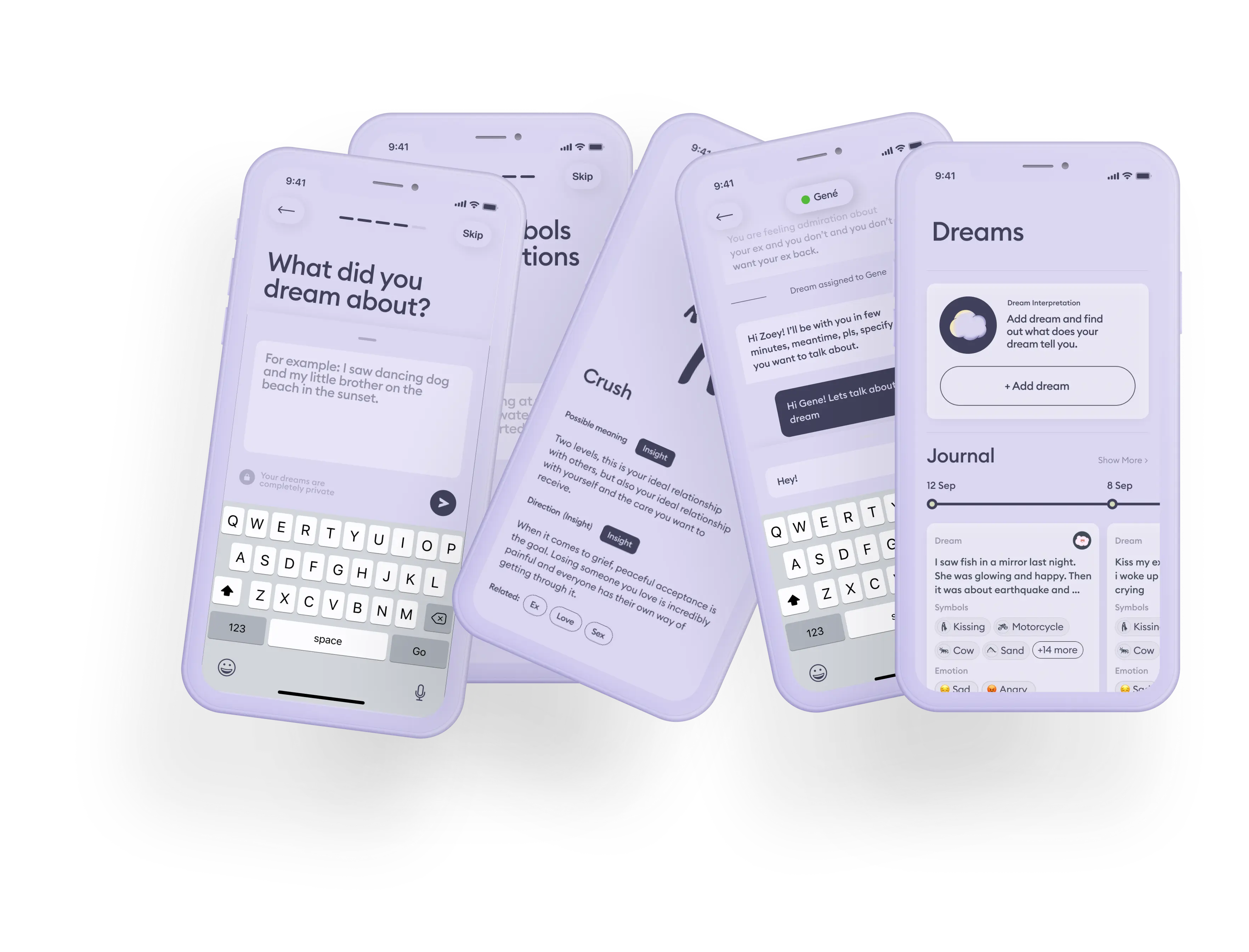
DreamApp, ours, is built around the symbol library and the psychology behind it. There are more than 1,600 symbols in the dream encyclopedia, each covering what the symbol commonly means, what feelings it tends to carry, and what to do with it, plus a journal, pattern tracking, and the option to talk to a psychologist. Web content is available in English, Spanish, Portuguese, French and German. It is free to start with an optional subscription, and holds 4.6 stars from about 3,900 ratings on the App Store. Where we are strongest is looking something up and getting a grounded answer. Where we are not the best pick: if lucid dreaming is your main interest, or you specifically want the same dream read through several competing schools of thought, the two apps above are built for that and we are not.
The questions worth asking before you pay
Does it work at 4am? Open the app half asleep, in the dark. If capturing a dream takes more than three taps, you will stop using it inside two weeks. This single test predicts more about whether an app sticks than any feature list.
Does the interpretation account for context? A snake means different things depending on whether it frightened you or fascinated you. An app that returns the same paragraph for snake regardless of what happened in the dream is a dictionary with a subscription attached, and free dictionaries exist.
What happens to your dreams? Dream journals are among the most personal things you will ever type into a phone. Look for local encryption or device locking, check whether entries are shared or public by default, and read the deletion policy before you commit years of entries.
Can you export? If you journal for three years and cannot get your entries out, you do not own your archive. Export to PDF or plain text should be table stakes.
Is the subscription honest? Check the renewal terms and how cancellation works before the trial ends, in any app, including ours. Set a calendar reminder for the day before a trial expires.
What no app can do
None of these products can tell you what your dream definitively means. Dreams draw on your own associations, and a symbol that reads as danger for one person reads as freedom for another. The honest role of any app here is to give you a well informed starting point and better questions, not a verdict.
They are also not treatment. If dreams are consistently disturbing your sleep, or nightmares are frequent and distressing, that is worth raising with a doctor or therapist rather than an app of any kind.
The most useful thing any of these tools does is far simpler than interpretation. It gets you to write dreams down consistently, so that patterns you would never notice from a single morning become visible over a year. In our own data, that pattern is striking: the most common dreams are not snakes and monsters but houses, cars and school, and fear leads a quarter of dreams while most still resolve positively. You only ever see that in your own dream life by keeping a record.
Frequently asked questions
What is the best dream interpretation app?
There is no single best one, because these apps do different jobs. Oniri is the strongest dedicated journal and lucid dreaming tool, Elsewhere offers the widest range of interpretive lenses plus dream imagery, DreamyBot is the fastest way to get an interpretation with no install, and DreamApp is built around a 1,600 symbol reference library grounded in psychology. Pick based on whether you mainly want capture, interpretation, pattern tracking or a quick answer.
Are paid dream apps worth it over a free dream dictionary?
Only if you want journaling and pattern tracking. If you look up a symbol two or three times a year, a free reference such as our dream encyclopedia covers it. Subscriptions earn their keep when you record dreams regularly and want to see recurring symbols and emotional patterns emerge over months.
Is dream interpretation scientifically valid?
Dream research supports the idea that dreams reflect waking concerns, emotions and memory processing, and that recurring themes are meaningful to the dreamer. It does not support fixed universal meanings for individual symbols. Treat any interpretation, from an app or a book, as a prompt for reflection rather than a fact about your life.


Did you have an unusual dream with this symbol?
Let's analyze this dream with our expert!
At least five words, please.

Your dreams are completely private
Take control of your dream emotions in the free mobile app


The most recent users' dreams
Go to the user dreams page




















© 2024 Dreamapp Ltd
Follow us on Social:



Dream App
Free dream interpretations

(1,213)