
Denys Chumak
13 Oct 2026
Dream About a Butterfly: What It Really Means
In short: A dream about a butterfly usually points to a shift already underway in your life, often one you're still adjusting to emotionally, not something to fear.
You woke up still picturing it, those wings opening and closing, maybe landing on your hand or drifting just out of reach. Now you're wondering if it meant something about a change you're going through, or if your mind was just replaying a pretty image from your day. Dreams about butterflies tend to stick with people longer than most, and there's usually a reason for that.
What a Butterfly Dream Commonly Means
Across most dream interpretation traditions, a butterfly represents transformation. That's not a coincidence of symbolism, it's biological. A caterpillar doesn't gradually morph into a butterfly, it essentially dissolves inside the chrysalis and rebuilds itself into something almost unrecognizable. When this image shows up in your sleep, your mind is often reaching for the closest real-world metaphor it has for a change you're living through, one that feels disorienting from the inside but will look like growth once it's finished.
That said, butterflies in dreams rarely mean just one thing. The species, color, behavior, and your emotional reaction all shift the meaning. A butterfly resting calmly on your shoulder reads very differently from one you're chasing and can never quite catch. Context is doing a lot of the work here, more than the symbol itself.
In broad strokes, butterfly dreams tend to cluster around a few themes: personal transformation, emotional fragility or beauty, freedom from something that was holding you down, and the sense that a chapter of life is closing so another can open. Carl Jung would have likely read the butterfly as a symbol of the psyche itself, since the Greek word for both soul and butterfly is the same, psyche. Freud, more grounded in instinct and desire, might have pointed toward the butterfly's association with lightness, pleasure, and the fleeting nature of beauty. Modern dream researchers are less interested in fixed symbols and more interested in what the image is doing emotionally, which is often a gentler and more useful way to look at it.
Common Butterfly Dream Scenarios
The details matter. Here are some of the most frequent variations people report, and what they tend to point toward.
A Butterfly Landing on You
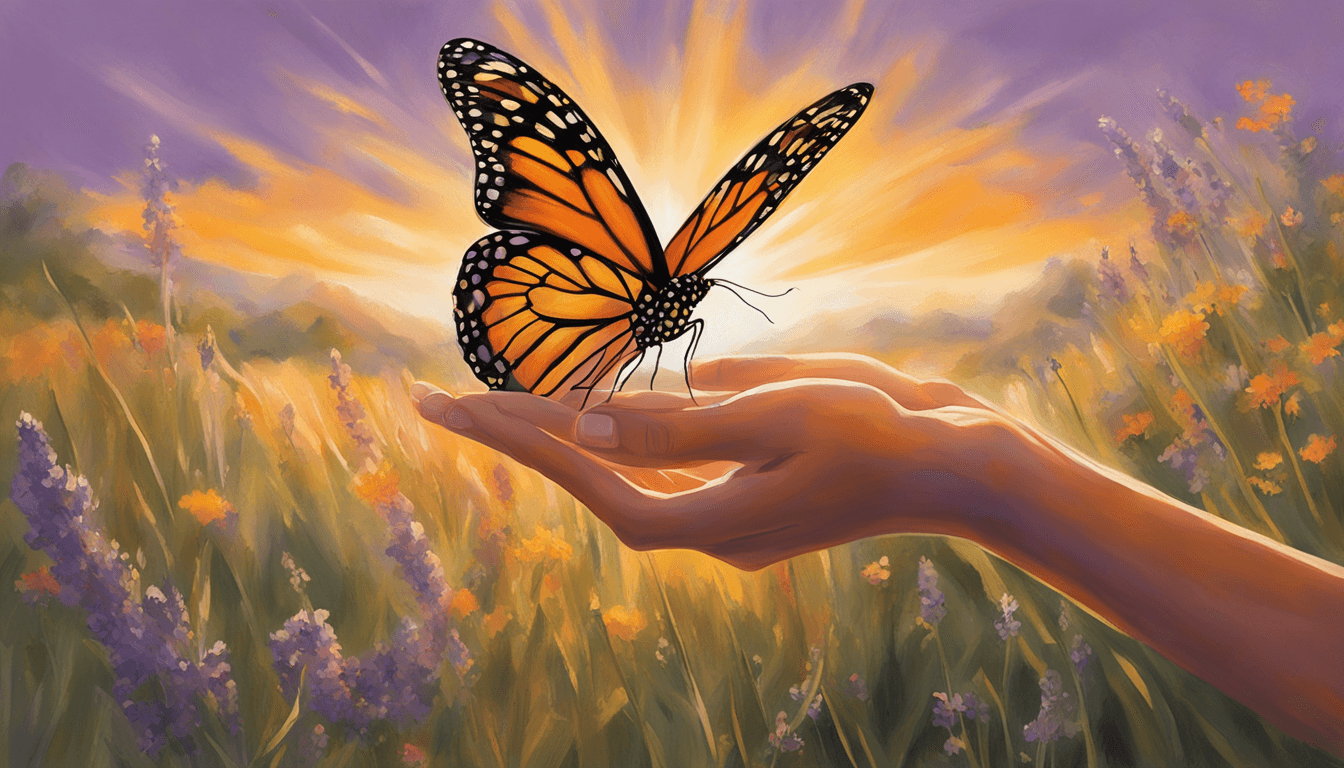
This is one of the most common butterfly dreams, and usually one of the most comforting. A butterfly landing on your hand, shoulder, or head often reflects a sense that something good is settling into your life, recognition, peace, or a positive change you've been waiting on. It can also suggest that you're finally letting your guard down enough for something delicate and good to come close. Butterflies are easily startled, so if one chooses to land on you in a dream, your subconscious may be telling you that you've created enough stillness for something fragile to trust you.
Catching or Chasing a Butterfly
If you spend the dream chasing a butterfly that keeps escaping, this often mirrors a real-life pursuit, a goal, a relationship, a version of yourself, that feels just out of reach. The emotional tone matters a lot here. If the chase feels fun and hopeful, it may simply reflect ambition. If it feels frustrating or exhausting, it might be worth asking what you're pursuing that keeps slipping away, and whether the pursuit itself has become more draining than the goal is worth.
A Swarm or Multiple Butterflies
Dreaming of many butterflies at once, sometimes filling a room or a field, tends to amplify the transformation theme. This can show up during periods of major life transition: a new job, a move, the end or start of a relationship, recovery from illness. The sheer number can feel overwhelming in the dream even if the butterflies themselves are harmless, which often reflects how change can feel flooding even when it's ultimately positive.
A Dead or Dying Butterfly
This one tends to unsettle people, understandably. A dead or injured butterfly in a dream doesn't usually predict anything literal. More often it points to a transformation that stalled, a hope that didn't pan out, or grief over a version of yourself or your life that didn't get to fully emerge. It can also surface during periods when you feel like your efforts toward change aren't being rewarded. Worth noting, this image sometimes appears right after a disappointment, a rejection, or a plan falling through.
A Butterfly Emerging from a Cocoon
Watching the actual metamorphosis happen in a dream, the cocoon splitting open, wings unfurling, is one of the more vivid and specific transformation dreams. This usually shows up when you're in the thick of a change rather than at its start or end, that uncomfortable middle stage where you're not who you were but you're also not yet who you're becoming. It can feel oddly validating to dream this, like your subconscious is confirming that the process, however slow, is actually working.
A Blue Butterfly
Color adds another layer. A blue butterfly specifically tends to carry associations with calm, communication, and emotional clarity rather than chaos. Many cultures link blue with the throat chakra and self-expression, so this variation sometimes appears when you're on the verge of saying something important, setting a boundary, or finally voicing a truth you've been sitting on. It can also simply reflect a desire for more peace during a transformation that otherwise feels turbulent.
The Psychological View
I used to dismiss butterfly dreams as a little too on the nose, almost like my mind was being lazy with its symbolism. But the more I paid attention to my own dreams during actual periods of change, a move across the country, leaving a job I'd outgrown, the more butterflies showed up, and the more specific the details became. It stopped feeling generic and started feeling pointed.
From a psychological standpoint, dreams don't usually invent imagery out of nowhere. They borrow from what you already know and feel strongly about, then rearrange it to process something you haven't fully worked through while awake. The butterfly works so well as a dream symbol because the transformation it represents is involuntary and uncomfortable in the middle stage, which mirrors how most real personal growth actually feels. You rarely feel graceful while you're changing. You feel strange, a little exposed, unsure if you're doing it right.
Research on dream content suggests that emotionally significant waking experiences, especially ones involving uncertainty or identity shifts, are more likely to surface in symbolic form during REM sleep. A butterfly dream, then, is less a prediction and more a reflection, your mind's way of giving shape to a process that otherwise feels formless. This lines up with what both Jungian and cognitive approaches to dreaming generally agree on: dreams are less about hidden messages waiting to be decoded and more about emotional processing that happens to use vivid, often beautiful, images.
When to Pay Attention
Most butterfly dreams are simply reflections of ordinary life transitions, and you don't need to treat every one as a sign. But a few patterns are worth noticing.
If butterfly dreams are recurring, especially with the same scenario or emotional tone each time, it's often a signal that whatever change you're processing hasn't been fully acknowledged while you're awake. Recurring dreams in general tend to persist specifically because the underlying feeling hasn't been resolved, not because the dream itself has unfinished business of its own.
Pay closer attention if the dream carries strong negative emotion, dread, grief, panic, rather than wonder or calm. A dead butterfly paired with intense sadness, for instance, might be worth sitting with longer than a quick one-line interpretation can offer. Ask yourself honestly what change in your life currently feels stalled, unsupported, or grieved.
It's also worth paying attention if the dream arrives at a specific juncture, right before a decision, right after a loss, right as you're starting something new. Timing often tells you more than the symbol does. A butterfly dream the night before a job interview is almost certainly about that interview, whatever the textbook definition of the symbol says.
Practical Steps
A few ways to actually work with a butterfly dream instead of just wondering about it:
- Write it down fast. Details fade within minutes of waking, especially color, location, and what the butterfly was doing. Those details carry most of the meaning.
- Name the change you're in. Even if it feels minor, write one sentence about what's shifting in your life right now, a relationship, a habit, a role, a belief about yourself.
- Check the emotional tone against your waking life. If the dream felt peaceful but your days feel chaotic, or vice versa, that gap is often the most useful piece of information.
- Notice the color and behavior specifically. A calm blue butterfly and a frantic swarm of orange ones are not pointing to the same thing, even though they're technically the same symbol.
- Revisit it in a week. Sometimes the meaning of a dream only becomes clear once you see how the real-life situation actually unfolds.
None of this requires treating the dream as a literal message from somewhere outside you. It's more useful to treat it as a mirror, one that's reflecting something you already sense but haven't put into words yet.
Frequently asked questions
Does dreaming about a butterfly always mean good news?
Not always, though it's one of the more positively associated dream symbols. Most butterfly dreams point toward transformation, freedom, or emotional lightness, but the specific scenario matters. A dead or injured butterfly, for example, often reflects a stalled change or a disappointment rather than good news on the way.
What does it mean if a butterfly dream keeps repeating?
Recurring butterfly dreams usually suggest that a transformation in your waking life hasn't been fully processed or acknowledged yet. Rather than predicting something new, the dream tends to repeat until you consciously deal with whatever change it's reflecting, a decision you're avoiding, a chapter you haven't let yourself close, or a shift in identity you haven't named out loud.
Is there a difference between dreaming of a caterpillar and dreaming of a butterfly?
Yes, and the distinction is meaningful. A caterpillar in a dream typically represents the early, uncertain stage of a change, before it's visible to anyone else. A butterfly, especially one that's just emerged from a cocoon, tends to represent the change becoming real or outwardly recognized. If your dream shows the full transformation happening, it often means you're closer to the other side of a change than you realize.
Explore the dream symbol
Butterfly →

Did you have an unusual dream with this symbol?
Let's analyze this dream with our expert!
At least five words, please.

Your dreams are completely private
Take control of your dream emotions in the free mobile app



The most recent users' dreams
Go to the user dreams page





© 2024 Dreamapp Ltd
Follow us on Social:



Dream App
Free dream interpretations

(1,213)